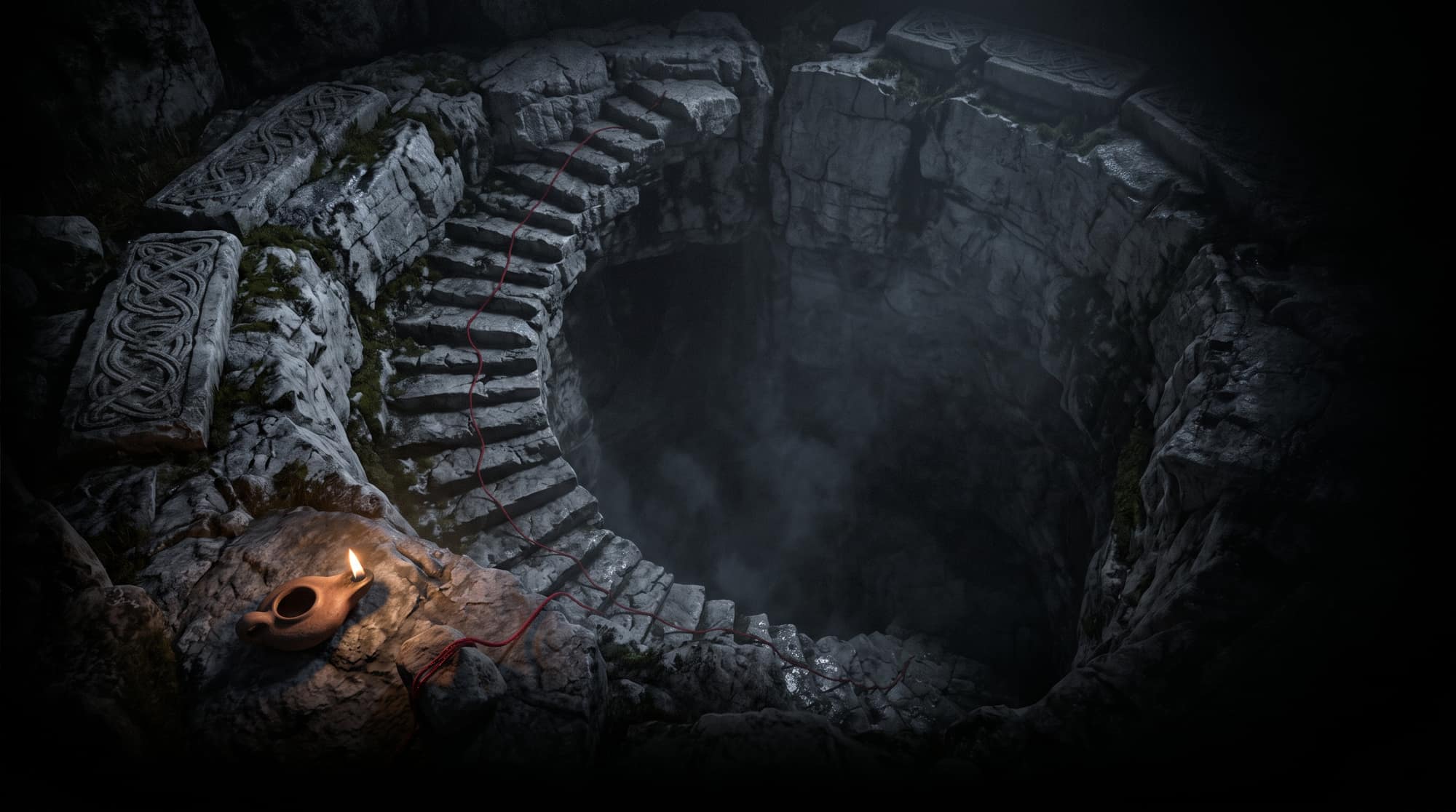
Dev Update #1 – The Interface, Carved in Stone
Every screen in Ponor is now carved from karst limestone: the menus, the panels, the tooltips and the HUD, all cut from one stone kit rendered in Blender.

The whole interface of Ponor is done, for now. Every button, panel, tooltip and menu is now cut from the same gray karst limestone, with the old interlace of Croatian church stone running through it and Glagolitic letters carved where you would expect a label. This was the last big job before the game's systems get their turn, and it changes how the game feels more than anything I have done so far.
Why stone?
Ponor is set in the karst of the Dinaric mountains, where everything is limestone: the houses, the walls, the caves you go down into. A clean fantasy UI floating on top of that world never sat right. I wanted the interface to feel like something the people of Kamenica could have carved themselves, the way Diablo II's felt like it was forged from the same dark iron as its world.
So the stone is sooty in its crevices and never marble-clean. The ornament is pleter, the three-ribbed interlace you find carved into old Croatian churches. And the letters are Glagolitic, the alphabet of the Baška tablet, cut into the stone rather than painted on.
How is it made?
None of it is painted by hand. Every carved piece, from the frames and the bar to the orbs' cradles and the knots in the corners, is modeled and rendered by a script in Blender at three times the size the game needs. Every piece is lit from the top left, like the item icons. That means I can change a moulding once and the whole kit rerenders to match, instead of repainting every sprite by hand.
Only the flat things stay flat: the hairline frames of the buttons, the grids of the bag, the lines of text.
Two kinds of frame
One rule decides how anything on screen is framed. Whatever docks to the edge of the screen or stands as a window is carved: the bar, the side panels, the main menu, the settings. Whatever floats over the world is knotted: a black box in a thin double line with a Solomon's knot in each corner. That covers the tooltip, the menu over a person, and the line of dialogue being read.
Tooltips now say what an item is before they say what it does, compare themselves with what you are wearing, and wash red when you cannot use an item yet, so you know before you buy or drag it. You can read more about the item rules on the equipment page.
Color means something
The stone stays gray and desaturated on purpose. When color appears, it is telling you something: the blue of a Magic item, the gold of a Unique, the red of Life, the blue of Mana, the red of Kosara's thread. Even the loot on the floor follows the rule.
When you arrive on a floor, its name is announced above Kosara's red thread, with the name carved again in Glagolitic beneath the knot.
The menus
The main menu is laid out after Diablo II Resurrected's: the game's tablet and your options on the left, your characters on the right, your hero standing in the light between them. A Hardcore character who fell stays in the list, grayed out, with the floor where it happened.
The settings got an Interface tab of their own, so you can turn damage numbers, the corner map, the numbers in the orbs and the life bars on and off to taste. The whole interface scales with your window, and you can shrink it further if you like a cleaner screen.
A second pass after playing it
After my first long play with the finished interface, I went back for a second pass. The Play button became a slab of the same stone, the new character screen moved into the right-hand column, tooltips became solid and moved above the cursor, names now hang over the world, and the map you open with Tab became an overlay like Diablo II's. Small things, but they are the difference between an interface you look at and one you stop noticing.
What comes next?
With the interface done, the next milestones are about what fills it. Equipment comes first: the full rarity ladder, level requirements and the rules for sockets. Crafting follows, with weaving, refining and sealing your gear at Kosara's and Tvrtko's. Both are designed and come next on the roadmap. You can see what is planned on the crafting page.
If you want to follow along, the next update will land in the RSS feed and in your inbox if you sign up below.